
Seismic Pipe Stress: Designing for Earthquakes
Seismic Pipe Stress: Designing for Earthquakes
In seismic regions, piping systems must withstand lateral accelerations without overstressing or compromising flexibility. JSC Engineers combines ASCE 7 seismic methods with ASME B31 design principles to ensure code-compliant performance under earthquake loading.
For a broader overview of how seismic loads integrate with flexibility and restraint design, see our Pipe Stress Analysis Services page.
Understanding Seismic Loading in Piping Systems
Earthquake effects on piping can be analyzed using equivalent static or dynamic response spectrum methods. In both approaches, the goal is to capture the lateral inertia forces that act on the piping mass and its supports during ground motion.
Static methods represent the earthquake as a horizontal acceleration (in g’s) applied to the piping system, while dynamic methods use response spectra to determine the maximum accelerations experienced by each vibration mode of the piping network.
Equivalent Static Method (ESM)
The Equivalent Static Method simplifies seismic loading by replacing dynamic forces with equivalent static forces proportional to pipe weight and seismic acceleration factors. It’s efficient for preliminary design or smaller, less complex systems.
- Basis: Forces are applied in orthogonal directions (X, Y, and sometimes Z) using acceleration factors derived from ASCE 7 or local building codes.
- Calculation: Equivalent acceleration (g) = Z · I · K · C · S, where parameters reflect seismic zone, importance, structure type, and soil class.
- Advantages: Fast setup, conservative results, and straightforward load case combination with thermal or operational conditions.
- Limitations: May overestimate loads and ignores damping or dynamic interaction effects.
Response Spectrum Method (RSM)
The Response Spectrum Method evaluates the true dynamic behavior of the piping system. It considers each natural vibration mode, calculating peak responses using a predefined response spectrum that represents ground motion intensity versus frequency.
- Approach: Uses modal superposition—each vibration mode is analyzed separately, then combined statistically (e.g., SRSS or CQC methods).
- Accuracy: Captures resonance effects and damping, giving a more realistic estimate of seismic stresses and support loads.
- Application: Recommended for complex or large-bore piping where dynamic interaction and multiple support levels affect performance.
Comparing ESM and RSM
Each approach has advantages depending on system complexity and project objectives:
| Aspect | Equivalent Static Method (ESM) | Response Spectrum Method (RSM) |
|---|---|---|
| Analysis Type | Static approximation of dynamic effects | Dynamic, mode-based response |
| Accuracy | Conservative, less precise | Higher accuracy, frequency-dependent |
| Computational Effort | Low | High |
| Best For | Simple layouts, preliminary sizing | Complex systems, critical infrastructure |
Design Considerations for Seismic Pipe Stress
- Input Data: Site-specific spectral accelerations (Ss, S1), site class, soil conditions, and importance factor.
- Anchors and Guides: Provide fixed points and controlled flexibility to prevent excessive displacement.
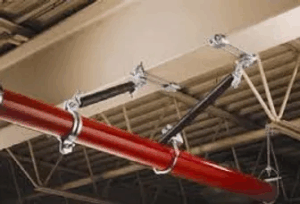
- Bracing and Snubbers: Add lateral stiffness and absorb transient loads while allowing thermal expansion.
- Support Reactions: Evaluate seismic anchor loads, support shear, and foundation capacity.
- Combined Load Cases: Include thermal, dead weight, pressure, and seismic loads per ASME B31.1/B31.3 allowable stress criteria.
Code References
- ASCE 7: Provides spectral parameters and base shear equations (V = Z · I · K · C · S · W).
- ASME B31.1 & B31.3: Define stress limits and combination rules for occasional loads such as earthquakes and wind.
- MSS SP-58/69: Establish requirements for seismic supports, snubbers, and bracing components.
Integration with Stress Analysis Software
Modern stress analysis tools such as CAESAR II and AutoPIPE can implement both ESM and RSM load cases. Engineers can import site spectra, define modal damping ratios, and combine seismic and thermal cases to verify compliance with ASME code allowable stresses. At JSC Engineers, we routinely perform both static and dynamic seismic assessments for critical process, power, and water infrastructure projects.
Related Reading
- Pipe Stress Analysis Services | ASME/CSA-Compliant Engineering
- Pipe Support Design: Anchors, Guides & Spring Hangers
- Mitigating Water Hammer & Flow-Induced Vibration
Work with JSC Engineers
JSC Engineers provides advanced seismic pipe stress analysis using both static and dynamic methods. Our expertise in ASCE 7, ASME B31.1/B31.3, and MSS standards ensures your piping systems meet code and perform reliably under seismic conditions.
Contact us to discuss seismic load modeling, support design, or delegated engineering packages for your next project.