
Pipe Stress Analysis for Pipework Vibration Problems
Pipe Stress Analysis for Vibration Problems
Pipework vibration is one of the leading causes of fatigue failures in industrial facilities. JSC Engineers integrates advanced pipe stress analysis with Energy Institute vibration screening to identify risks early and develop targeted, constructible solutions that protect equipment and prevent failures.
Piping vibration challenges appear across refineries, chemical plants, compressor stations, and offshore platforms. While many vibration issues surface as an operational problem, they almost always tie back to underlying stiffness, flexibility, and load paths that must be evaluated through proper pipe stress analysis.
What Is a Pipework Vibration Assessment?
A pipework vibration assessment is a structured evaluation of dynamic behavior in process piping systems. JSC Engineers measures vibration levels across mainline piping, small bore connections, and supports, then compares the results against Energy Institute guidelines to determine risk levels and required corrective actions.
The assessment combines field measurements with stress modeling to capture how dynamic loads travel through the system and where fatigue failures are most likely to originate.
Why Vibration Problems Are a Pipe Stress Problem
Pipe stress analysis is the backbone of understanding vibration behavior because vibration is directly influenced by pipe stiffness, support spacing, mass distribution, and load paths. Even when the root cause is acoustic or flow related, the pipe stress model is what reveals whether the system can withstand the dynamic forces.
- Stiffness too low: excessive vibration amplitude, resonant response, small bore failures
- Stiffness too high: thermal overstress, nozzle overload, support overconstraint
- Poor support layout: amplified motion at branch connections and nozzles
- Incorrect flexibility: conflicts between vibration control and thermal movement
The challenge is balancing thermal flexibility with dynamic stiffness, and this requires a coordinated approach across both static and dynamic stress analysis.
What Causes Piping Vibration?
Vibration originates from three primary excitation mechanisms:
- Acoustic and pulsation loads: pressure oscillations, dead leg pulsation, AIV near pressure reducing devices
- Momentum loads: turbulence, multiphase slugging, flashing, cavitation, transient flow events
- Mechanical loads: vibration transmitted from pumps, fans, compressors, and rotating machinery
Even when excitation is unavoidable, pipe stress analysis determines whether the pipe has the stiffness and restraint capacity to resist fatigue stresses.
Small Bore Connections: The Leading Failure Point
Nearly eighty percent of vibration induced failures occur at small bore connections. These include vents, drains, bypasses, instrument taps, PSV connections, and other branch details that are highly sensitive to local stiffness and dynamic amplification.
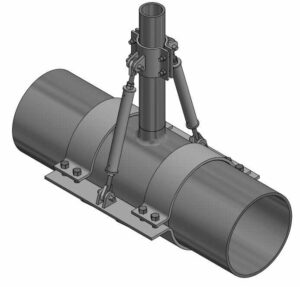
JSC Engineers evaluates each connection under the Energy Institute screening process, then applies detailed finite element analysis where needed. Proprietary JSC support options can be used when field reinforcement is required, including:
- JSC Quick Brace for rapid structural stiffening
- JSC Dynamic Absorber for targeted frequency control
- JSC Vibration Damping Module for high frequency attenuation
The Role of Pipe Stress Analysis in Vibration Control
Pipe stress analysis is performed alongside vibration field measurements to understand the complete behavior of the system. Key outputs include:
- Natural frequency calculations for piping and small bore connections
- Dynamic stress evaluation under vibration loads
- Support optimization for stiffness, damping, and load distribution
- Identification of resonant spans and mode shapes
- Nozzle load checks under combined thermal and dynamic loading
- Verification of support loads under fluctuating forces
Vibration cannot be solved by field bracing alone. The system needs the correct stiffness profile at the global level, and this requires full stress modeling that is consistent with B31.1 or B31.3 code requirements.
Energy Institute Guidelines and Risk Based Screening
The Energy Institute AVIFF guideline is the industry standard for evaluating vibration risk. JSC Engineers applies this methodology in combination with detailed pipe stress modeling to identify:
- High likelihood of failure locations
- Excitation sources across multiple operating modes
- Necessary field measurements for verification
- Corrective actions based on quantitative vibration limits
This structured, repeatable approach ensures the most critical locations are identified early before costly failures occur.
How JSC Engineers Resolves Vibration Problems
Our integrated approach combines stress analysis, field testing, and custom support design to deliver a complete solution:
- Pipe stress model review for stiffness and support layout
- Mechanical natural frequency testing
- Flow induced vibration screening
- Acoustic induced vibration assessment
- Finite element evaluation of small bore details
- Design of new supports or reinforcement
- Commissioning vibration checks
We collaborate closely with mechanical, structural, and operations teams to ensure the solution works across thermal, dynamic, and constructability constraints.
Why This Matters for Facility Owners
Piping vibration affects safety, uptime, environmental risk, and equipment reliability. By integrating vibration assessment with proper pipe stress analysis, facilities can:
- Reduce fatigue failures and leaks
- Prevent high consequence hydrocarbon releases
- Increase equipment reliability and runtime
- Eliminate costly field rework
- Improve overall integrity management
Need Support With Pipework Vibration and Stress Analysis?
JSC Engineers provides complete vibration and pipe stress engineering services for refineries, power plants, chemical facilities, and industrial projects.
To discuss your project or request a proposal, visit our contact page.