Nozzle Load Compliance: API 610/617 & WRC Methods
Nozzle Load Compliance: API 610/617 & WRC Methods
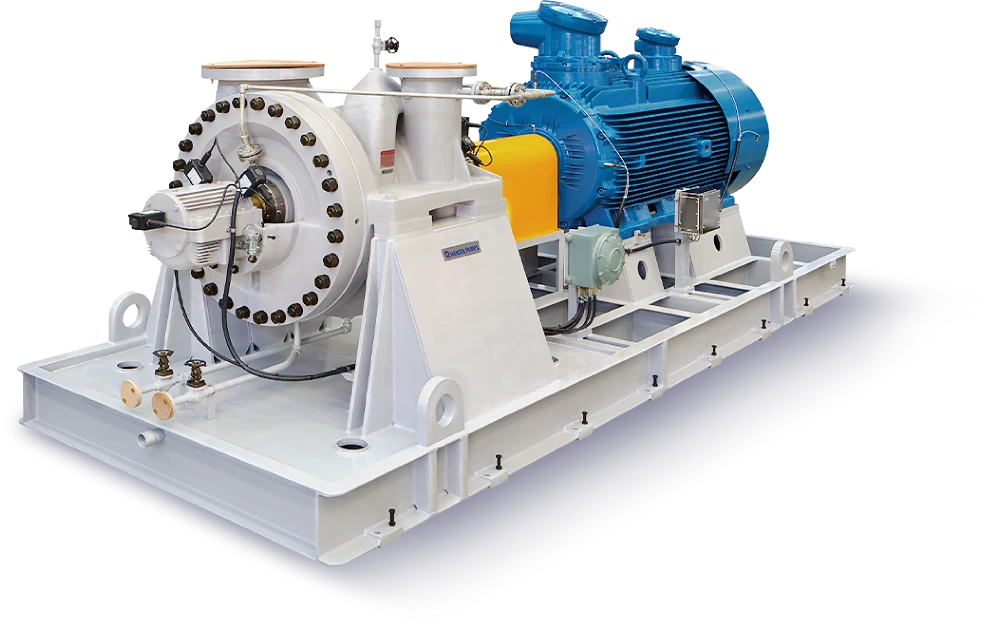
Meeting pump, compressor, and turbine nozzle limits is essential for reliability and uptime. JSC Engineers integrates API 610, API 617, and NEMA SM 23 criteria with WRC/FEA local checks to align piping flexibility with equipment allowables—before problems reach the field.
For a broader view of how equipment loads fit within system flexibility and supports, see our
Pipe Stress Analysis Services page and our
Pipe Support Design guide.
Why Nozzle Loads Fail
- Insufficient flexibility: Long, stiff runs that transmit thermal growth directly to equipment.
- High friction near nozzles: Sliding shoes without low-friction pads or rollers elevate moments.
- Poor restraint strategy: Anchors or line stops placed so growth “pushes” on equipment.
- Dynamic effects: Vibration (mechanical, pulsation, or surge) layering on top of static loads.
- Construction tolerances: Misalignment, cold spring errors, or unaccounted mill tolerances.
Standards & Vendor Criteria
Most rotating equipment is checked against published or vendor-provided allowables:
- API 610 (centrifugal pumps): Component limits by nozzle size, plus resultant checks. Editions differ in how “heavy-duty” baseplates and resultants are treated; modern editions consolidate tables and provide special cases for vertical inline pumps.
- API 617 (compressors): Resultant force/moment limits by nozzle geometry; often evaluated similarly to turbines.
- NEMA SM 23 (steam turbines): Resultant-based criteria with diameter terms; multiple combined limits must be satisfied.
- User/Manufacturer allowables: When equipment is non-standard, we check against vendor matrices in global or local coordinates.
How We Evaluate Nozzle Loads
- Model the nozzle as an anchor/reference point at the equipment connection and extract reactions from CAESAR II or AutoPIPE for the governing load cases (sustained, thermal expansion, occasional, and combined).
- Check per the applicable standard: First confirm individual components (Fx, Fy, Fz, Mx, My, Mz), then resultant force/moment limits; where allowed, apply edition-specific combination rules (e.g., conditional ratios for pumps).
- Cold vs. hot equipment modeling: For hot service, include thermal growth of the equipment casing or use “rigid” elements with appropriate offsets to avoid under- or over-predicting reactions.
- Coordinate systems: Align sign conventions and axes (top/end/side nozzle orientation) with the standard or the vendor sheet.
Reducing Nozzle Loads (Practical Fixes)
- Routing for flexibility: Add strategic offsets or loops to re-vector growth away from the nozzle.
- Restraint strategy: Move anchors/line stops so that thermal expansion “runs away” from equipment; guide long runs to prevent lateral instability without over-constraining.
- Lower friction: Replace shoes with PTFE slide plates or rollers; avoid binding supports near nozzles.
- Vertical travel support: Use variable/constant springs to carry weight while allowing displacement.
- Expansion joints (as a last resort): Where justified, consider pressure-balanced bellows near the suction/discharge; confirm EJ stability, squirm margins, and tie-rod adequacy.
- Local reinforcement: Thicker tees/elbows, repads, or nozzle neck upgrades where local stresses govern.
Local Stress Evaluation: WRC & FEA
When nozzle forces/moments are near limits—or vendor data is unavailable—evaluate local shell/nozzle stresses:
- WRC (legacy 107/297; updated 537/538): Empirical methods to estimate stresses at shell-nozzle junctions due to external loads.
- FEA (shell-solid models): Submodel the nozzle region for stress linearization (membrane + bending) and compare to allowable local limits (e.g., per ASME Section VIII Div 2 Part 5 for pressure parts where applicable).
- Nozzle neck & weld details: Check weld size, repads, offset loads, and local ovalization/peak stress.
Vibration, Pulsation & Seismic Effects
Nozzle compliance isn’t only static. We screen dynamic contributors and add them where required:
- Mechanical vibration: Rotating equipment forces (unbalance/shaft frequencies) → harmonic displacement inputs and nozzle stiffness modeling.
- Pulsation (FIV): Acoustic harmonics from compressors/pumps → harmonic force inputs; ensure modal mass capture and realistic damping.
- Water hammer/Surge: Time-history forces or coupled fluid transients where applicable.
- Seismic: Use Equivalent Static or Response Spectrum methods; combine with thermal and sustained per ASME B31 rules.
Allowables, Fatigue & Combined Cases
- Code combinations: Combine sustained, thermal expansion, and occasional loads (wind/seismic) per ASME B31.1/B31.3.
- Occasional vibration cases: Define separate harmonic combinations where vendor criteria require checking alternating loads.
- Fatigue screening: For high-cycle vibration, compare calculated alternating stresses against project/vendor fatigue allowables and adjust supports, stiffness, or routing as needed.
Workflow We Use on Projects
- Gather inputs: Vendor allowable sheets, nozzle orientations, casing growth, allowable loads coordinate system, and baseplate class (for pumps).
- Build/load models: Pressure, temperature, weights, support friction, realistic boundary conditions, and equipment stiffness (if provided).
- Run cases: Sustained, expansion, occasional, harmonic/seismic as required.
- Check compliance: API 610/API 617/NEMA SM 23 or vendor tables; document pass/fail by component and resultant.
- Mitigate & iterate: Apply the reduction techniques above; re-check local stresses via WRC/FEA when near limits.
- Deliverables: Calculation package, nozzle load report tables, support drawings/notes, and constructability comments.
Related Reading
- Pipe Stress Analysis Services | ASME/CSA-Compliant Engineering
- Pipe Support Design: Anchors, Guides & Spring Hangers
- Seismic Pipe Stress: Designing for Earthquakes
- Mitigating Water Hammer & Flow-Induced Vibration
Work with JSC Engineers
From quick screening to detailed dynamic and local stress assessment, JSC Engineers helps teams achieve nozzle compliance without over-design. We coordinate with vendors, adjust routing and supports, and provide sealed calculation packages and delegated design drawings.
Contact us to review your nozzle loads or request a compliance study.